Friday, November 12, 2010

Beyond My School

As I wrap up my time in Arusha, I thought it would be worthwhile to share a little bit about some of the other volunteer work being done here and give a bit more perspective on the challenges facing Tanzania and its children.  (I'll be leaving Arusha to hike Kilimanjaro today.  I'll tell you all about it and share my last Tanzanian tales when I'm back home.) 

Errat Care Center
The pictures below are at The Errat Care Center.  It's a non-profit seeking to provide education to children on the outskirts of the city.  It is also striving to provide community education programs to help adults learn new skills to better provide for their families.  As limited as the resources are at the Jue school, here it is even worse.

It is in the middle of nowhere, surrounded by dirt and dry, brown grass.  It is a shell of a building - the roof doesn't meet the ceiling, the windows are open, the floor is dirt, and the warped blackboard rests on cinder blocks.  When it rains, everything gets wet, and the class clusters in the center of the room.  One girl walks an hour each way to get there.  As part of her trek, she has to cross a big gorge.  Unfortunately, she can't cross it to go to school when it floods in the rainy season.  And she is lucky...she is the only kid in a town of 40 who goes to school at all.

There is a single teacher at the school who is only 19 years old.  She speaks limited English, but tries to teach it to the children.  During the first lesson my friend Claire saw her teach, she told the children that the "arm" is the "hand."  The classroom is generally chaotic with kids ranging in age from 3 to 7 years old.  They are all taught the same thing at the same time.  Claire has made great strides teaching some of the children their numbers and letters while older children are learning English greetings and colors.

Besides a basic lack of educational resources, these children are medically challenged beyond the normal dirtiness of kids here.  There is a very sickly looking boy with HIV (who just got sponsored to go to a real school.)  There is a girl with a black and infected thumb.  Scabies and ringworm are endemic.  Claire actually bought scabies meds for a whole family...a mom, the student, and a baby.  The son had scars on his back from scratching them so hard.  One treatment and he was cured...for now.

Claire has also been working to help get funding to dig a well for the community.  Now, people walk hours each day to get water...which is opaque and muddy.

Living here is more than rough.

The school "building."
Cinder block walls, dirt floor, and decrepit blackboard.
No toys?  A shoe becomes a car.
Even so...all smiles with Claire.


Cradle of Love
Cradle of Love is a baby orphanage.  As I've mentioned before, there are countless orphans in Tanzania, largely due to the AIDS epidemic.  This orphanage is run by an American family.  In the grand scheme of things, it is a very nice facility, complete with a playground.

The children are adorable and love to play.  One of their first words is "again!"  They do cry a lot though and constantly want to be picked up and held.  They are held so often in fact that many experience delayed walking.

The stories of some of the children are incredible.  Karen was brought in by her grandparents because her parents basically left her in a corner to die.  Vivian, who is blind and has cerebral palsy, was left in a closet to die, but was discovered by her neighbors when they heard her crying.  Pendo was starving because her father was dead, and her mother didn't have work and couldn't feed her.  She was skeletal when she arrived at Cradle.  As she's gained weight, she's been relearning how to walk.  And she's been smiling again...with the dimples she had lost in her emaciated face.

Life here is hard, but there is hope.

Nothing beats being held.
The kids just love to be hugged.


Wednesday, November 10, 2010

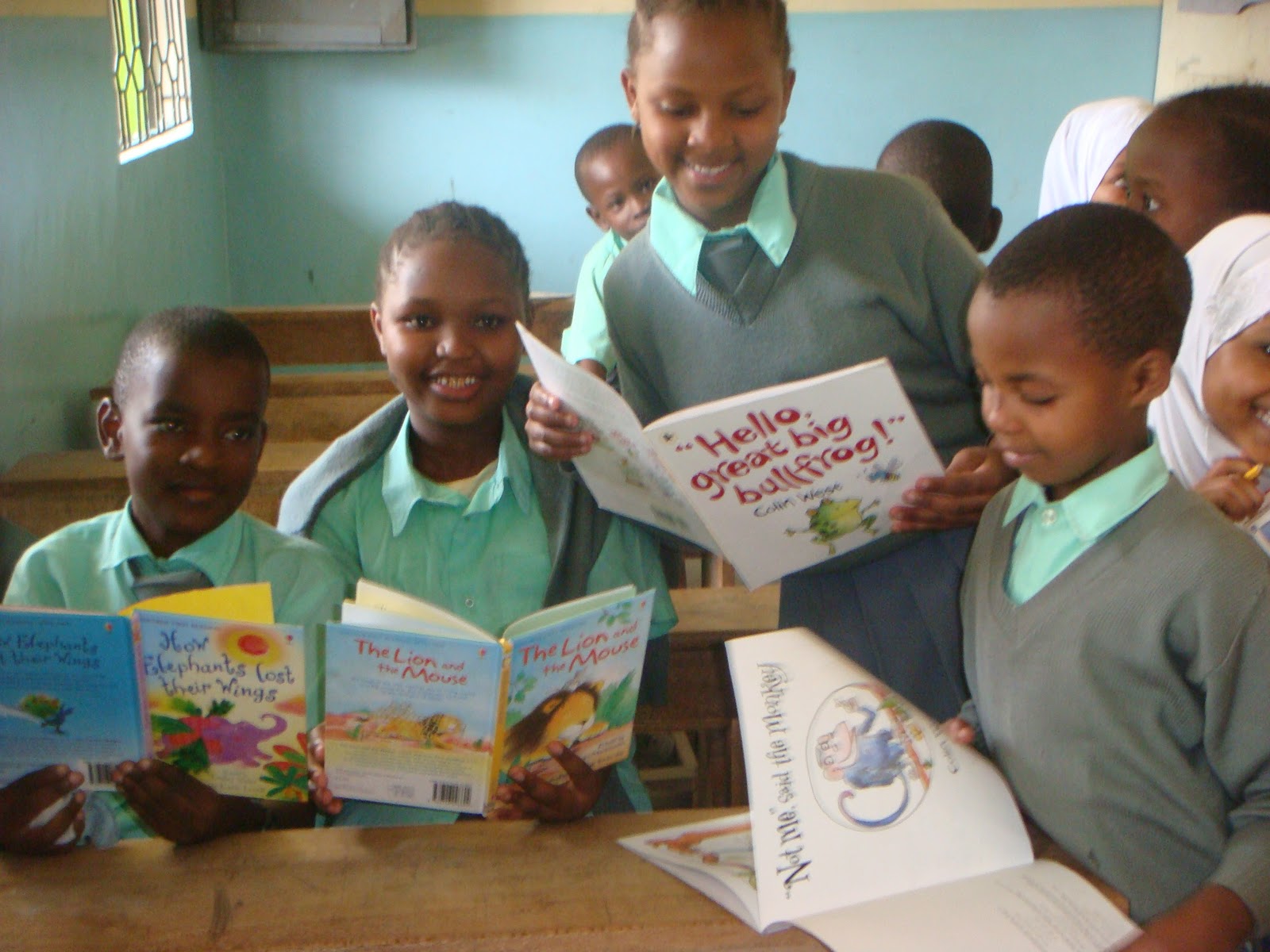
Kids and Books!


A great big thanks to all of you who have donated!  And these kids were not posed - they really were this excited to get the books and read them all!!

Sunday, November 7, 2010

School Days Again

It's almost hard to believe that I haven't always been a teacher.  It's by far the hardest thing that I have ever done, but it has also been by far the most rewarding.  5 weeks ago, I had absolutely no idea what I was doing; now, I have a bit of an idea at least and have been working hard to make the most of my short time here.

It has been fun figuring out how to challenge the children and get them to think beyond the standard practice of simply parroting the teacher and copying what's on the board into their notebooks.  I've discovered that  they actually like to be pushed hard.  When they finish their math assignments, I'll give them extra, increasingly hard problems, and they'll keep coming back for more.  They'll even scrounge around for extra paper so I can make them problem sets to take home.  Instead of just copying a story off the board, I'll ask them to think of what happens next and to share it with the class.  To encourage the kids to pay attention and participate in class, I'll throw bits of trivia into the class presentation - Ben Franklin flying a kite and key into a cloud to discover electricity, 'shovel' as a synonym for 'spade', or the saying "sweet dreams" that we use before going to bed.  The kids who pay attention and remember the trivia, get stickers.  I also give stickers for 100%, and there have been quite a few proud kids who have shown them off to their Tanzania teachers.  I've also tried to make learning vocabulary like 'fever' fun by creating a "hot and cold" song and dance.  The kids love to sing and dance - I've got some great videos to share once I'm home.

Besides actual teaching instruction, I've introduced a number of games that American school children love.  Some are purely for fun while others offer a bit of education at the same time.  Tic-Tac-Toe was a huge hit right off the bat although the strategy has been tough for some of the kids to pick up, and Simon Says was perfect for teaching the kids the English words for various body parts.  Otherwise, classics like Heads Up - Seven Up, Red Rover, and Duck - Duck - Goose have become playtime favorites.

Thanks to help from one of the teachers, I've been able to form a reading group with six children from first and second grade.  These children are at the bottom of their grades and basically can't read.  I've put together daily reading lessons that another volunteer teacher and I have been using to tutor them.  It has been a real emotional roller coaster.  One minute, they can read "fat, sat, cat" and the next minute they will seem to have entirely forgotten.  They can't even read basic words like "the" or "on" without constant review and repetition.  Bright, who was the first boy to read a word for me, is picking it up quickly - he can rapidly read lists of rhyming words once he learns the rhyme; he can turn "at" to "cat" and "sat" and "et" to "pet" and "get."  But he'll forget the rhyme because he doesn't remember the sounds the vowels make.  A boy in second grade, George, read his first sentence the other day and was beaming with pride.  He forgot it the next day, but got it faster the second time.  So, we go at it, day after day, making a little bit of progress, sliding back, and then moving forward again. 

The kids in tutoring and all of the other children love books - literally clamoring for the few that I bring out at lunch time.  Thanks to the kind donations that have been made so far, I've been able to buy a variety of books that I am very excited to donate to the school.  The donations are greatly appreciated (if you are even thinking about donating, please do, it means so much to me and these kids)....I have so much more to do to get the library started in such a short time, but I'm determined to get it done.

There is nothing like hearing an excited chorus of "Teacha!  Teacha!" every morning and being greeted with hugs and kisses and High Fives. Nothing like it except that look on a child's face when he realizes that he can read and that someone cares.

Wednesday, November 3, 2010

Stranger in a Strange Land

It's been almost a month since I wrote about my first impressions of Tanzania.  In that time, I've grown fairly comfortable here - that is, I've grown used to just about everything even if I still think it's strange.  Of course, no matter how comfortable I feel here, I'm still a mzungu - a foreigner, a European, a white person.

As a white person, you stand out here, no question, and "spotting the white person" is something of a safari for Tanzanians.  Walking down the street, you are greeted with a chorus of "mzungu, mzungu, mzungu" with a pointing finger or a wave.  Little kids, old people.  Everyone thinks it's quite a sport.  It's funny at first and then gets annoying...some white folks have even bought shirts that say things like "well spotted...I'm a mzungu" or with just the simple "MZUNGU" emblazoned in all caps.  I almost can't blame the Tanzanians...I've done a double take myself when I've seen another white person that I don't already know!  But could you imagine walking down the street pointing people out by race at home?  Most of it is in good fun, and people are generally excited to give you a high five (which is a fist pump here) and ask you your name and where you are from.  Unfortunately, some Tanzanians aren't so welcoming...it hasn't happened to me, but some other volunteers have had Tanzanians get off the dala when they get on, or refuse to get on when they see them, or move their seats away from them.

As a mzungu here, you are very aware of the line between the haves and the have-nots - they exist in two entirely separate worlds.  You can retreat to a Western restaurant that serves 4 course meals and where the only non-mzungus are the wait staff.  You can then step outside this very restaurant and find two brothers, in rags, living on the street, with nothing to eat.  (One volunteer offered to buy these children new shirts.  When the little brother picked a white one, the older brother/parent, reminded him that that wasn't a good choice because it would be harder to wash in the river.) Of course, the divide isn't just between white and black.  There are Tanzanian families with big houses and satellite tv, whose kids watch cartoons and play video games in the internet cafes.  And then there are Tanzanian families who live in dirt huts without running water, electricity, or food.

Overall, the lack of infrastructure is a huge adjustment.  The water company just doesn't have enough water to supply the city because the country is so arid - plus, a water pump broke and the replacement has to be shipped in from Sweden.  As a result, our house has been buying water privately - a man arrives before dawn every morning pulling a huge cart loaded with barrels of water that he painstakingly pours into our cistern.  There isn't any means of garbage disposal - trash either gets tossed into the street or burned alongside it.  Huge clouds of smoke billow everywhere - burning everything you can think of (bottles, CDs, papers) - filling the air with a pungent, acrid smell.  If your nose isn't already burning from the smoke, it's probably scratchy from the dust.  Dust is everywhere and on everything - clean doesn't exist here.  Your feet are black when you take a shower and they're black when you get out of the shower - as soon as you remove the dirt from under your nails, there's more dirt under your nails.  You get comfortable with dirt - clean is a luxury.  This is even more true because of how you do laundry.  Laundry machines and driers don't exist.  Your clothes go into a bucket with, per the instructions on the package, "enough soap to do the washing."   (Ummm, how much is that exactly???)  And then you scrub and scrub until your arms and back ache, and then you rinse, and wring, and hang the clothes on the line.  What we do at home is NOT laundry....THIS is laundry!!  This is more than laundry actually...it's a backbreaking workout!
Filthy Feet
 In spite of the dust and the shortage of water, car washes are a major industry here.  They line the roads one after another.  I can't figure out why the Tanzanians are so fixated on keeping their cars clean...when the roads are potholed and dusty and their clothes are often dirty and full of holes.  Cars rule the roads here...pedestrians beware...you don't have the right of way.  People zip by you at breakneck speeds in cars, dalas, flatbed trucks hauling people as cargo, and on the back of motorcycle taxis (bodas).  Taxis can pack as many people into them as the car can hold, and no one wears seatbelts or uses child safety seats.  Traveling is cramped, hot, and sweaty, but you'd never know it looking at the Tanzanians - they routinely wear winter hats, parkas, and fleeces...while the mzungus are baking in long pants and t-shirts.  One kid came to school wearing a winter coat many sizes too big - well past his knees - when it was easily 80 degrees!  And if they aren't wearing excess clothing on their bodies, it's probably on their heads.  I've seen people carry bags and pots and things on their heads before, but here they carry things for sale on their heads too - very movable commerce!

The most annoying thing I've discovered is the complete lack of understanding of the concept of waiting in line.  It's a free-for-all at the grocery checkout, in public restrooms, and in school for grading.  Elbows come in handy to help stand your ground.  You also have to be on the lookout for creative math and changeable pricing on receipts...some days it seems everyone thinks that every mzungu is rich and stupid and easily parted from his/her money.

Of course, for every bad egg out there, there are great people too.  It's a wonderful day when someone stops you and says "thank you" for being here.  And on those days, you don't feel so strange.

Sunday, October 31, 2010

Pix!


Ok - pix might a bit of an overpromise - but with the slow speed of the internet connection, I could only get a few up.  These are pictures taken on Friday during "sports."  As you can see from the pictures, the kids are dressed in their exercise uniforms.  Sports actually amounts to running around in the gravel area in front of the school, playing tag or chasing a soccer ball.  On Friday, it mostly included chasing Teacher Kathryn.

The kids were super excited about the camera.  I am in most of the pictures because the kids all wanted to try their hand at photography.  To their credit, they did a pretty good job - I only ended up with a few shots of their hands.  We probably took pictures for a solid twenty minutes...they can't get enough of seeing pictures of themselves.

You may also have noticed that I placed a donate button at the top of my blog.  This is in response to the numerous thoughtful requests I have received to help send school supplies.  Unfortunately, the mail is notoriously unreliable and highly prized things like pencils and sharpeners usually get stolen en route.  I figured the easiest way for those who are interested to help would be by setting up a secure paypal account - I can use the donations to buy supplies here in Tanzania.  One of the initiatives I am working on particular is starting a library at the school.  The kids love to read - but simply don't have any books.  They read and reread their dog-eared textbooks for fun.  I think that a library would be a wonderful thing to leave behind to be enjoyed by countless children.

I thank you in advance if you choose to donate.  I will continue to update my blog with the status of the library initiative as well as the purchase of other standard supplies.  And there will be more pix!

Wednesday, October 27, 2010

Curriculum a la Tanzania

  1. "My father likes to drink whiskey."
  2. "The man got drunk at the wedding party."
  3. "The boy drank poison in a cup."
  4. "The fat man has an ass."

True or False: The sentences above are suitable for teaching young children how to read________.

Most Westerners would probably answer "False" for the age inappropriate content and language.  However, these are sample sentences actually taken from a beginner's English book here in Tanzania.  Imagine, reading with a 7 year old and helping him to correctly pronounce "ass" - like "'a' as apple" - when you discover this sentence following the innocuous example "the cat sat on the mat."

Overall, the material that is taught to kids here is very matter-of-fact.  The content simply isn't edited to create a sanitized kid version - probably because the kids are basically seen as little adults.  The information also conveys general safety and health precautions that can help keep them from getting sick or hurt rather than more abstract educational concepts.

For example, science class has focused heavily on body cleanliness.  The kids had several classes on how to bathe, including the various items used for proper hygiene.  It was all very true to Tanzania - the illustrations featured naked people squatting in front of a bucket and pouring water on themselves from a pitcher.  The course covered toothbrushes and toothpaste, but I doubt very many of the children actually know what these are since their teeth are brown and rotten.

Science class has also covered the importance of not drinking dirty water and the diseases that can be carried by mosquitoes and house flies.  This section was tastefully illustrated with paired images of a naked man urinating and defecating near water sources - which the students were admonished never to do.

The most serious topic that they have covered is the transmission of HIV.  Since HIV has decimated the Tanzanian population and left many of the children at the school with only one parent (if they're among the lucky ones), this class makes a lot sense.  It was still striking nonetheless to hear these kids reciting the ways you can catch and transmit the disease in their little singsong voices.

As to their personal safety, their science book warns them not to get too close to wild animals such as crocodiles.  To drive this point home, the illustration depicted a crocodile taking a huge, bloody bite out of a man.  I guess I wouldn't go near one after seeing that picture...but I thought, "geez, this book is for kids. Did it have to be so gory?"

The curriculum in Tanzania really drives home the differences between the kids' lives here and at home; here, kids are expected to be little adults, to help the family earn money, and not have a protected childhood per se; here, staying alive and healthy is still a basic concern, ahead of having fun and learning for learning's sake; here, it's still very much about surviving versus thriving.

Wednesday, October 20, 2010

Kids are Kids

No matter where in the world you are, people are people and kids are kids.  The kids may wear different clothes, speak a different language, and eat some strange stuff (eg, goat's blood), but they all laugh with joy and love being tickled and hugged. And they all cry and get angry when they are hurt.  Kids anywhere really are just kids everywhere.

There are 140 children who are lucky enough to be students at my school.  In spite of the educational standards I described before - lack of basic resources and a chaotic learning environment - the school is actually ranked 16 out of 14,000 schools in Tanzania.  This statistic is fantastic, but it doesn't tell you anything about what it is like to be a student in the school every day - the super smart kids who are going unchallenged or the slower learners who can't read and act out in class out of boredom and frustration or the kids who just need love.  Here are a few profiles of these kids. 

Sonia - pronounced "Sew-knee-a;" Sonia is sharp and speaks English very well.  She can read English easily.  She was out sick this morning but still got 100% on her classwork - how to use "ing" at the end of a verb.  This seems pretty easy - until you realize how many exceptions there are.  "Cut" becomes "cutting" with a double 't' while "snore" becomes "snoring" losing the 'e.'  She just knew these answers without having been in the lesson.  She likes Hannah Montana and her "sparkly" shoes.  She loves to learn vocabulary and is always asking for me to teach her new words.  She reads and rereads her tattered textbooks when she is done with her assignments in class.  She was the first student to understand how to play tic-tac-toe and usually beats the other students - and sometimes even me.  She likes to help me grade the papers and listens raptly to me as I talk.  I always try to give her extra questions to work on to keep her challenged.

Rehema - pronounced "Re-hee-ma;" Rehema is an adorable Muslim girl.  Some days she wears a headscarf and sometimes she doesn't.  Because of the Muslim population in Tanzania, women don't show their knees - so no shorts for tourists even on hot, hot days.  When "shorts" was a vocabularly word that I explained by showing where "short pants" go above the knee - and that women wear them, including me - her mouth dropped open in total surprise and then laughter.  When I first arrived, she was so shy I couldn't get her to answer any questions in class.  Today was a big day.  After I demonstrated the meaning of snoring by "snoring" loudly, I asked the class if they knew anyone who snored.  She was the first on her feet raising her hand and proudly proclaimed, "My father!"  It seems like a small thing, but for Rehema, these two words were a very big deal.  She was glowing with pride since she made the class laugh.

Franklin - pronounced just like it looks! (many of the children use English names); Franklin is 7 but looks about 5.  He barely talks.  He has an older sister in the next grade who looks almost exactly like him.  Both he and his sister live in the school's hostel.  What this means is that he and his sister don't have any parents or family who can support them, so they live at the school.  There are about 40 other orphans who live in the hostel and attend school for free as part of the school's charity program.  For these kids, the education is almost secondary.  It's attention that they need most.  As soon as I walk in the door in the morning, Franklin wraps his arms around my legs or gives me a hug and won't let go.  He loves to sit in my lap as I grade papers and sometimes just sit in my lap, with his arms around my neck, and his head on my chest.  The most important thing I can give him is comfort and love.

Bright - just like it looks (many of the children have unusual English words for names, such as Nice, Gift, and Innocent); Bright comes across as a troublemaker.  He sits in class chewing on a pencil with a vacant look on his face.  He turns in his papers at the end of class, usually half done.  He's often caught in the back of the room, rough housing with other boys instead of doing his work.  You might be tempted to think that Bright isn't bright - but I think he actually is.  He just can't read, and no one has tried to help him.  I realized this yesterday when I caught him trying to hide his workbook at the bottom of my grading pile.  I made him sit with me to read his work...and he simply couldn't.  Once he realized that I wasn't going to hit him (which is what happens to students who misbehave), he relaxed and worked on sounding out some words with me.  Later, he came by the desk and was playing with a book - he said 'yes' immediately when I asked if he wanted to try more reading.  As big a day as it was for Rehema, it was an even bigger day for Bright today.  I taught him the "s" sound in "sun," the "a" sound in "apple," and the "t" sound in "tongue" (all words they have learned in class), and he sounded out "sat" for himself.  The big grin on his face was priceless when I told him it was right.  Two hours later, he forgot the word, but still remembered the "s" sound and later read "pat."  I really hope that this is the beginning of his real education.


For each of these children, there are many more like them in my classes.  I wish I had the space to write about them all because they are all the sweetest kids who deserve to have their stories told.  When I leave the school at the end of the day, I feel a bit like the Pied Piper because there are so many children holding my hand and following me home.  I almost wish that I could take them all the way home to the US and away from this system.  They all have so much potential.  And some great, great laughs.